

|
|
|
What Is the Building Strong Families Project?
|
||
Latest WorkThe Effects of Building Strong Families: A Healthy Marriage and Relationship Skills Education Program for Unmarried Parents (February 2012)This article in the Journal of Policy Analysis and Management examines the impacts of Building Strong Families, a healthy marriage and relationship skills education program serving unmarried parents who were expecting or had recently had a baby. Results varied across sites, with one site having a pattern of positive effects and another having numerous negative effects. However, when impacts are averaged across all sites, findings indicate that the program had no overall effects on couples' relationship quality or the likelihood that they remained together or got married. BSF's Effects on Couples Who Attended Group Relationship Skills Sessions: A Special Analysis of 15-Month Data (May 2011)This report uses two quasi-experimental research techniques to examine the effects of Building Strong Families, a relationship skills education program for unmarried parents, on couples who received the core program service of relationship skills group sessions. The analysis finds no strong evidence of Building Strong Families’ effects on the couples’ relationships, with one exception. Among the 3 in 10 couples who attended at least half of the group sessions offered, Building Strong Families appears to have increased the likelihood, by 7 to 10 percentage points, that these couples were living together (married or unmarried) at the 15-month followup. Initial Implementation of a Couples-Focused Employment Program (October 2010)This report evaluates the initial implementation of the Couples Employment (CE) project in Baltimore, Maryland, a voluntary intervention to simultaneously address employment, financial literacy, and relationship issues, to capitalize on the ways that success in each might affect the other. Initial experiences highlighted the importance of defining a program model integrating family stability and economic success, identifying a strong program director,achieving an appropriate staff mix, and maintaining a focus on couples. Strengthening Unmarried Parents’ Relationships: The Early Impacts of Building Strong Families (May 2010)This report provides impacts of BSF on couples about 15 months after they applied for the program. Early impacts show that, when results are averaged across the eight individual programs included in the evaluation, BSF did not achieve its primary objective of improving the stability and quality of the couples’ relationships. Results varied across the eight programs with positive effects for one program and negative effects for another. Other programs had little or no effects on relationships. BSF had overall positive effects for African American couples—improving the quality of their relationships. The Building Strong Families Project: Implementation of Eight Programs to Strengthen Unmarried Parent Families (May 2010)This report documents the design and implementation of the eight BSF programs, reports on services received by couples enrolled in the program, analyzes characteristics of couples and programs that may affect participation, and describes the experiences of program group couples. 15-Month Impacts of Oklahoma's Family Expectations Program (August 2010)This report presents findings from an analysis of the implementation of Family Expectations, one of the programs examined in our Building Strong Families study, and a rigorous evaluation of program impacts on couple and family outcomes. After 15 months, couples in Family Expectations showed significantly greater improvement in their relationship quality, father involvement, co-parenting, and maternal psychological well-being, compared with control couples. |
||

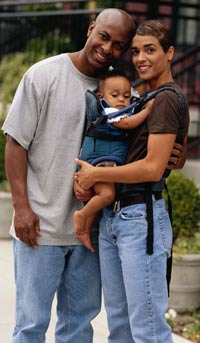 Strengthening and stabilizing the relationships of low-income couples has emerged as a focus of national policy development and testing. If unmarried parents can be helped to fulfill their aspirations for stable, healthy lives together, there could be important benefits for child well-being. Building Strong Families (BSF) is an initiative to develop and evaluate programs designed to help interested unwed parents achieve those goals. This website is designed to document the progress of the BSF project, the services being tested, and the results of the evaluation. For a description of the Building
Strong Families project,
Strengthening and stabilizing the relationships of low-income couples has emerged as a focus of national policy development and testing. If unmarried parents can be helped to fulfill their aspirations for stable, healthy lives together, there could be important benefits for child well-being. Building Strong Families (BSF) is an initiative to develop and evaluate programs designed to help interested unwed parents achieve those goals. This website is designed to document the progress of the BSF project, the services being tested, and the results of the evaluation. For a description of the Building
Strong Families project,